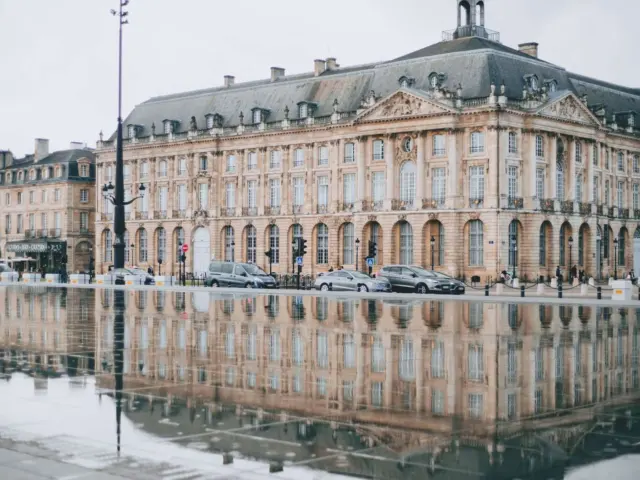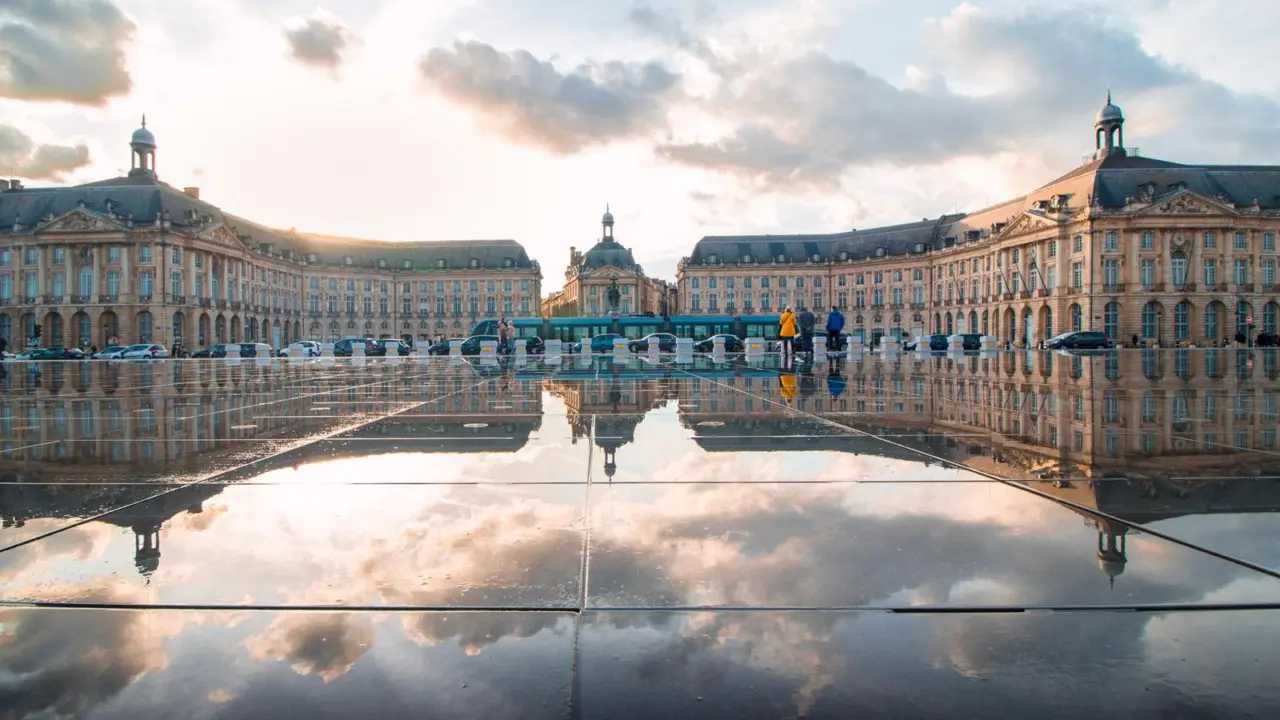
Planning a visit to the place de la bourse bordeaux and unsure what you’re looking at? You’ll see a royal square facing the Water Mirror, a granite pool that was built in 2006.
This page is one part of the wider bordeaux travel guide for the city.
| Item | Value |
|---|---|
| Water Mirror built | 2006 |
| Water Mirror surface | 3,450 square metres |
| Water depth | 2 cm |
| Misting nozzles | About 900 |
| Underground reservoir | 800 cubic metres |
These figures come from Bordeaux Tourism and Spotting History. Figures can change, so check the source before you rely on them.
What is the Place de la Bourse?
The Place de la Bourse is a square on the Garonne quay in Bordeaux, and Wikipedia calls it one of the city’s most recognisable sights. It describes a multi-building development built from 1730 to 1775 along the river.
Directly in front of it lies the Miroir d’eau, the Water Mirror. The Bordeaux tourist office places it between Quai de la Douane and Quai Louis XVIII and credits landscape artist Michel Corajoud with the design.
The two work as a pair: an 18th-century royal square and a pool that Spotting History dates to 2006. The city magazine Le Bonbon argues that the pool only reflects the beauty of Bordeaux, and that the square is the real star.
The 18th-century square and its buildings
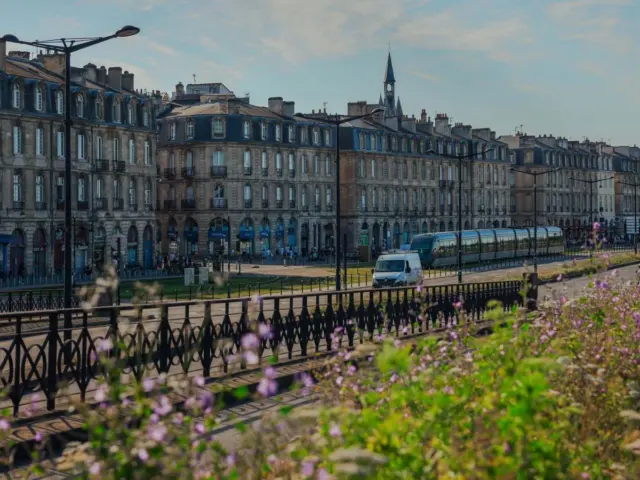
The square marks a break with the medieval city, which had been surrounded by walls for centuries, according to the tourist office. Wikipedia gives the build dates as 1730 to 1775, while Le Bonbon gives 1730 to 1755, so treat the end date as approximate.
Wikipedia credits the architect Jacques Gabriel and his son Ange-Jacques Gabriel with the design. Le Bonbon names Ange-Jacques Gabriel as the king’s architect behind the plans, so the safest reading is a Gabriel family project.
Two buildings frame the square, as of the Wikipedia page last edited on 5 April 2026:
- North: the Palais de la Bourse, listed as the Chamber of Commerce and Industry of Bordeaux.
- South: the Hôtel des Fermes, listed as the Interregional Directorate of Customs and Indirect Rights, which houses the National Museum of Customs.
- Sculptures: Minerve protecting the arts and Mercury favoring the commerce of the city.
Le Bonbon says the National Museum of Customs found a home in the southern building in 1984. The square also sits within the historic part of the city that Wikipedia says was included on the UNESCO World Heritage List in 2007 as “an outstanding urban and architectural ensemble” of the 18th century.
If the facades interest you, the guide to bordeaux architecture goes deeper into the style.
How the centrepiece changed over the years
The square was first planned around a statue of Louis XV, which was destroyed during the French Revolution, according to Wikipedia. The tourist office adds that railings once separated the square from the river, and these also disappeared during the Revolution.
The centre of the square then changed several times:
- A Tree of Liberty was planted after the statue’s removal.
- In 1828, a fountain shaped like a pink marble column with a white capital and a globe took the centre, according to Le Bonbon.
- In 1869, the Three Graces sculpture was installed in the same location.
Le Bonbon says the Three Graces fountain was designed by Louis Visconti and shows Aglaé, Euphrosyne and Thalie, the daughters of Zeus. The same page notes Victor Hugo’s description of the square as half of Place Vendôme set on the water.
The name changed too. Per Le Bonbon, it was Place Royale, then place de la Liberté during the Revolution, then place Impériale under Napoleon, then Place Royale again at the Restoration, and finally Place de la Bourse in 1848.
How does the Water Mirror work?
The tourist office describes a loop of water, pumps and valves beneath a granite slab. The sequence runs like this:
- Water is stored underground in an 800 cubic metre reservoir.
- It is pumped to the surface and distributed through around a hundred channels beneath the slab.
- The water flows through the joints in the slab and spreads over the whole surface.
- After a period pre-programmed by a computer, solenoid valves let the water return to the reservoir to regain its optimal temperature.
- Some 900 injectors, one in the centre of each tile, then generate fog, followed by the mirror effect.
The result is only 2 cm of water on the slab. Lonely Planet’s French guide says the fog rises several times an hour and turns walkers into ghostly silhouettes.
On size, Spotting History gives the area as 3,450 square metres and calls it the world’s largest reflecting pool. Le Bonbon, in a page updated in February 2024, makes the same claim.
Seeing the Water Mirror: what to expect
Lonely Planet’s French guide describes a large blue granite slab covered in water that draws tourists and families alike. In summer, it says, the pool turns into a kind of mini beach where a crowd gathers to cool off.
For the reflection, the same guide says to stand with your back to the river, where you can see the 18th-century facades mirrored in the water. The tourist office calls it the most-photographed site in Bordeaux.
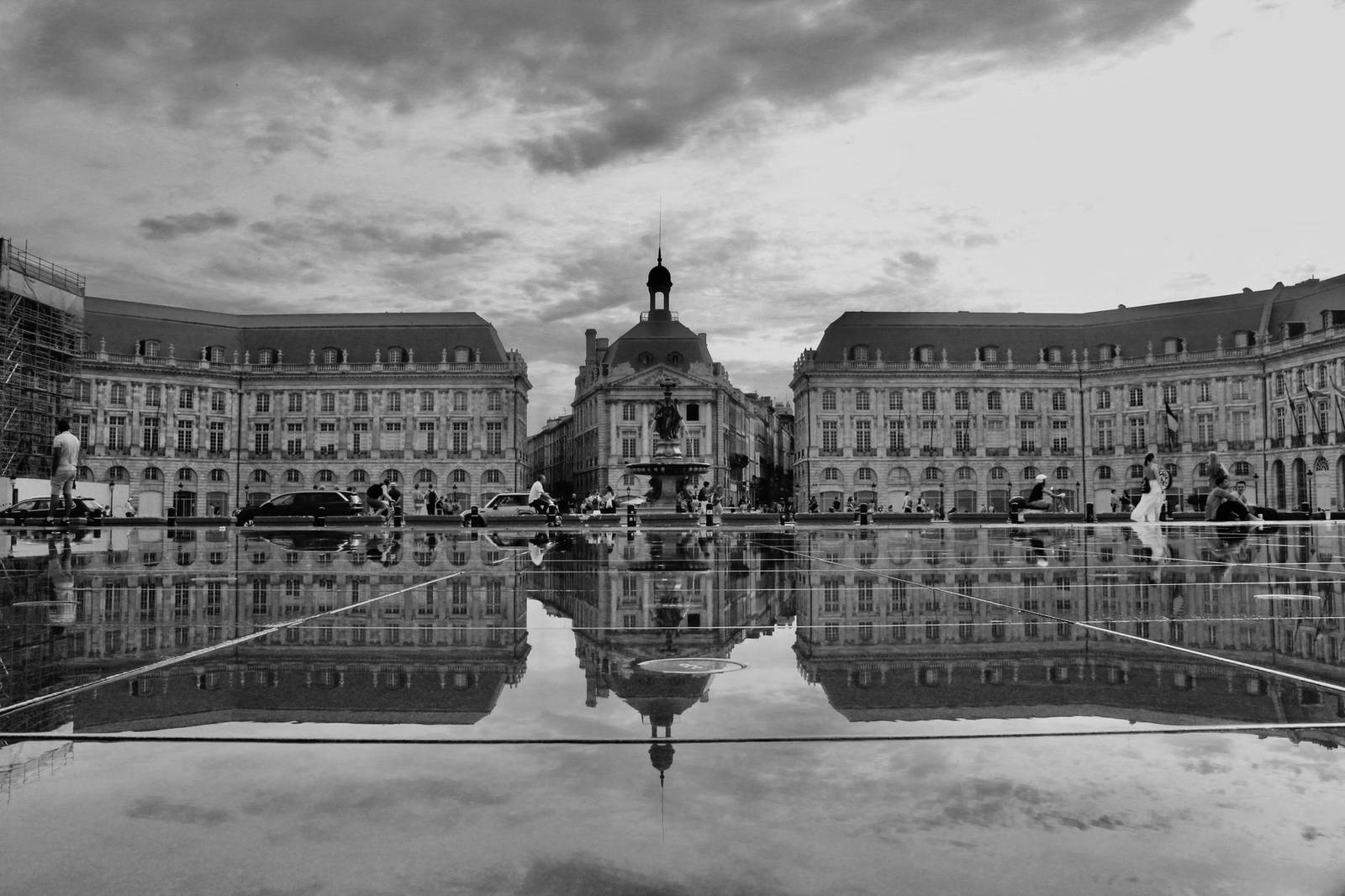
Because the mirror effect takes over after the fog, you can wait for the mirror phase to return if a clear reflection is what you want. For viewpoints beyond this quay, see the notes on photography spots in bordeaux.
Spotting History lists three historic sites within walking distance of the square:
- Grand Théâtre de Bordeaux, 0.3 km.
- Porte Cailhau, 0.3 km.
- Place des Quinconces, 0.5 km.
Frequently asked questions
When was the Water Mirror built?
Show answer
Spotting History says it was built in 2006, and Le Bonbon gives 2006 as its date of entry into service.
How deep is the water?
Show answer
The tourist office describes 2 cm of water on the granite slab. Lonely Planet’s French guide says there is no danger for children because the water is only 2 cm deep.
Who designed the Water Mirror?
Show answer
The Bordeaux tourist office credits landscape artist Michel Corajoud with the design.
Is the Place de la Bourse a UNESCO site?
Show answer
As of the Wikipedia page last edited on 5 April 2026, the square lies within the historic part of the city that was included on the UNESCO World Heritage List in 2007.
What stands in the middle of the square?
Show answer
The Three Graces fountain, installed in 1869 according to Wikipedia and Le Bonbon.