Want your pictures to say something, not just show something? Good conceptual photography ideas start with a single thought, then stage a scene that makes it visible. Pick a feeling or statement first, and the camera work follows.
This guide is part of the wider topic of fine art photography, where the idea behind a picture often matters as much as the technique.
| Item | Value |
|---|---|
| Working definition | Photography that illustrates an idea |
| Term began to be used | 1960s |
| Early staged photograph (Bayard, Self Portrait of a Drowned Man) | 1840 |
| Richard Long, A Line Made by Walking | 1967 |
| Martha Wilson, A Portfolio of Models | 1974 |
These figures come from Tate’s art term entry on conceptual photography and TheCollector’s overview of the subject. Dates and descriptions can change as sources are revised, so check the source before you rely on them.
What conceptual photography means in practice
Conceptual photography is photography that illustrates an idea, as the Tate art term entry puts it. The concept comes first, and the image is built to carry it.
Staging a scene for the camera is almost as old as the medium. Tate points to Hippolyte Bayard’s Self Portrait of a Drowned Man, dated 1840, as one of the first staged photographs, and says the term itself began to be used in the 1960s, alongside Conceptual Art (Tate).
A handy test comes from Wikipedia’s description: the concept is preconceived and, if successful, understandable in the completed image. The same page warns that the term is not widely used or consistently applied, so expect people to define it differently.
Conceptual photography ideas borrowed from art history
You do not need to invent a method from scratch. Artists have left behind a toolkit of approaches you can adapt to your own subject.
- The deadpan record. Tate describes Richard Long and Dennis Oppenheim recording performances and temporary artworks in a manner now often called deadpan, aiming for simple, realistic images that look as documentary as possible. Long’s A Line Made by Walking, dated 1967 in the Tate collection, is a good model: walk, mark, photograph plainly.
- The invented character. In A Portfolio of Models (1974), Martha Wilson chose clothing, styling and a pose for each figure, then paired each photograph with a short text, according to TheCollector. Try it with an exaggerated version of a role you know well.
- The self-timer entrance. Giovanni Anselmo placed his camera facing a field and ran into the frame once the timer was on, producing Entering the Work (1971), per TheCollector. The idea is simple, and the result is about the act of making.
- Object, word and picture. Joseph Kosuth’s One and Three Chairs (1965) pairs a dictionary definition, a manufactured chair and a photograph of the chair, as TheCollector explains. Pick an everyday object and ask what a picture adds to its name.
- Series, typology and restaging. Wikipedia lists documenting performance (Sherman), typological or serial imagery (Ruff) and the restaging of events (Demand) as methods shared with conceptual art.
- The rule-bound project. The same page says Sophie Calle’s practice replaces subjective expression with clinical protocols, arbitrary constraints and predetermined rituals. Set yourself a rule, follow it strictly, and let the pictures record what happens.
Pick one approach and keep it for a whole project. Mixing every method at once usually muddies the idea rather than deepening it.
Ideas that express feelings and stories
Some of the most expressive conceptual photography ideas begin with something you cannot photograph directly, such as dread, grief or restlessness. StudioBinder names the challenge: expressing internal experiences in an external way. Staging a scene is one answer.
Man Ray’s L’Inquiétude (1920) shows how far this can go, since TheCollector says he tentatively represented an emotion rather than a material subject. You can work the same way: choose the feeling, then find the object, light and gesture that stand in for it.
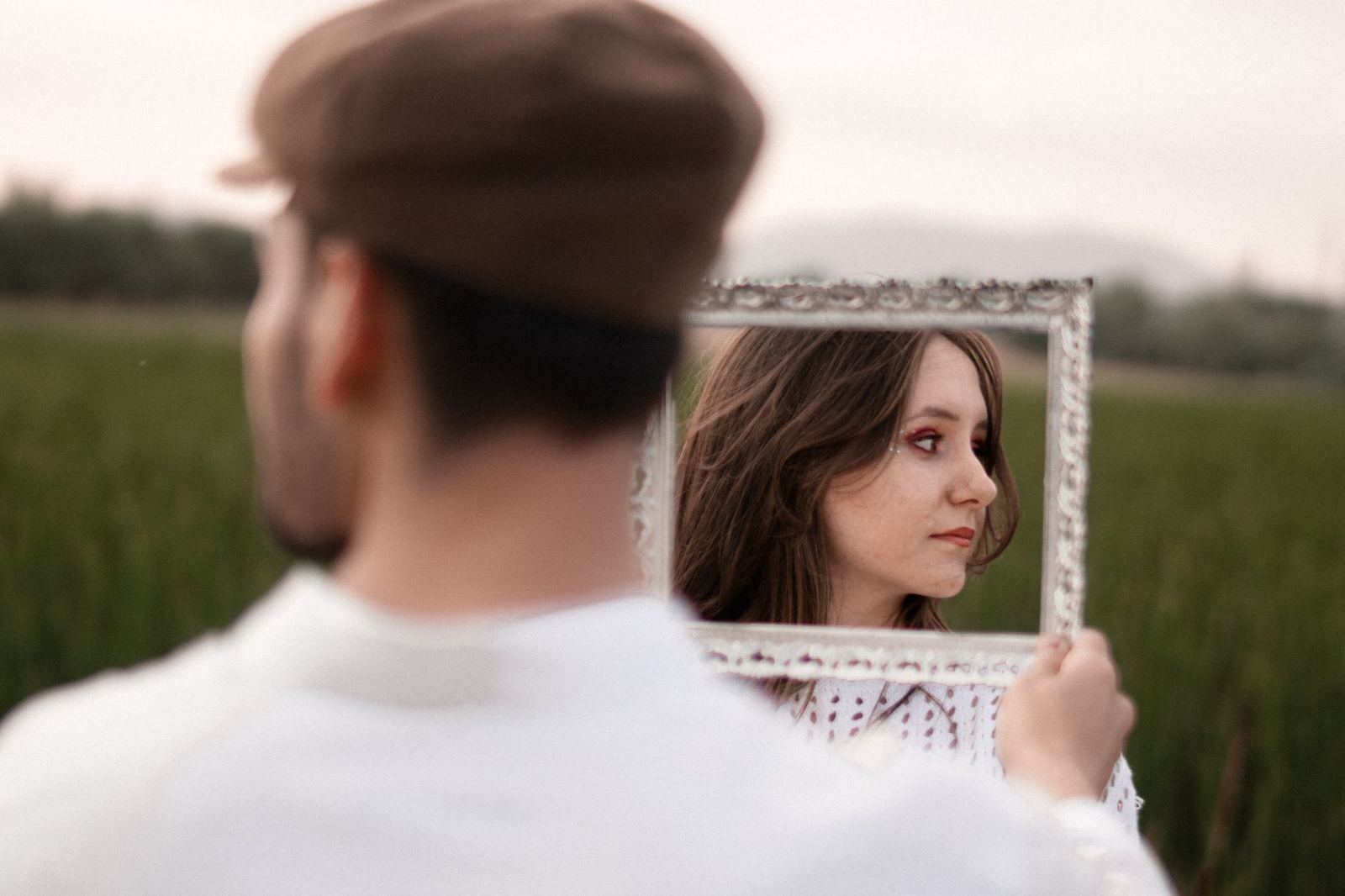
Here are prompts to start from, each built around a single idea:
- Anxiety: a figure pushed to the edge of the frame, with the empty space doing most of the talking.
- Memory: a childhood object placed in a bare, unfamiliar room.
- Consumerism: StudioBinder describes a barcode projected onto subjects so its shadow resembles a jail cell, reflecting how people can be captive to consumerism. Borrow the logic, not the picture.
- Identity: the same person photographed in several costumes, so the clothes become the subject.
- Time: a staged scene that repeats weekly from the same viewpoint.
- Isolation: a crowded place photographed so that one person appears entirely alone.
How to turn an idea into a finished image
An idea only becomes a photograph when you plan how the viewer will read it. Work through these steps in order.
- Write the idea as a single sentence, such as “waiting makes a room feel larger.”
- List the visible clues that could signal it: props, colour, pose, location, light.
- Sketch a rough frame, so you know where each clue sits before you pick up the camera.
- Shoot several versions. Change one variable at a time, and keep the strongest.
- Edit with restraint. Tate notes that editing software such as Adobe Photoshop lets anyone create an image other than a direct representation of what was in front of the lens, but remove anything that does not serve the idea.
- Decide whether a title or short text helps. Wilson’s short texts, noted by TheCollector, show how words can steer a reading.
Show the result to someone who has not heard your concept. If they describe something close to it, the picture works; if not, change the clues, not the idea.
Where it sits in fine art, and how to present it
According to Wikipedia, while all conceptual photography is fine art, not all fine art is conceptual. That makes your work a type of fine art practice, which helps when you choose how to show it.
Colour is a conceptual decision too. Removing it can strip a scene down to shape and tone, and the guide to black and white fine art photography is a useful companion when you test that choice.
Print choices change how an idea feels in the hand. TheCollector notes that Anselmo’s work has been printed on paper or fabric and in different sizes, and the notes on fine art photography printing cover how paper and finish shape the result.
You can also keep the whole project online. Tate cites Amalia Ulman as a photographer who used Instagram to create an entire narrative around a fictional identity, which shows that a feed can be the artwork.
Frequently asked questions
What is the easiest way to start with conceptual photography?
Show answer
Write one sentence describing the idea, then choose a single object or gesture that stands for it. Keep the scene simple, and shoot it a few different ways.
Do I need Photoshop to make conceptual images?
Show answer
No. Tate cites staged photography as early as 1840, long before editing software, and deadpan in-camera records are part of the tradition. Software only widens the options.
Is conceptual photography the same as fine art photography?
Show answer
Not quite. Wikipedia says the central school of thought is that conceptual photography is a type of fine art photography, though the two terms are sometimes used interchangeably and the dispute is not fully settled.
Do I have to take the photographs myself?
Show answer
Not necessarily. TheCollector says most conceptual artists were not photographers, and performance artists would have friends or hired photographers record their pieces. What matters is that the idea is yours.